
River stones are widely used in construction because of their natural hardness, durability, and resistance to weathering. However, their naturally rounded shapes and smooth surfaces make them difficult to process into high-quality manufactured sand and fine aggregates. Producing well-graded, cubical particles from river stones requires specialized crushing and shaping equipment rather than conventional primary crushing machines alone.
A well-designed river stone crushing plant typically combines secondary and tertiary crushing equipment, particularly high-efficiency cone crushers, impact crushers, and Vertical Shaft Impact (VSI) crushers. These machines help achieve the required particle size, improve aggregate shape, and maximize fine sand production while maintaining operational efficiency.
1. Recommended Machines for Fine Crushing and Particle Shaping
Selecting the right crushing equipment is essential for transforming river stones into fine particles suitable for concrete, asphalt, road construction, and manufactured sand production.
Vertical Shaft Impact (VSI) Crusher
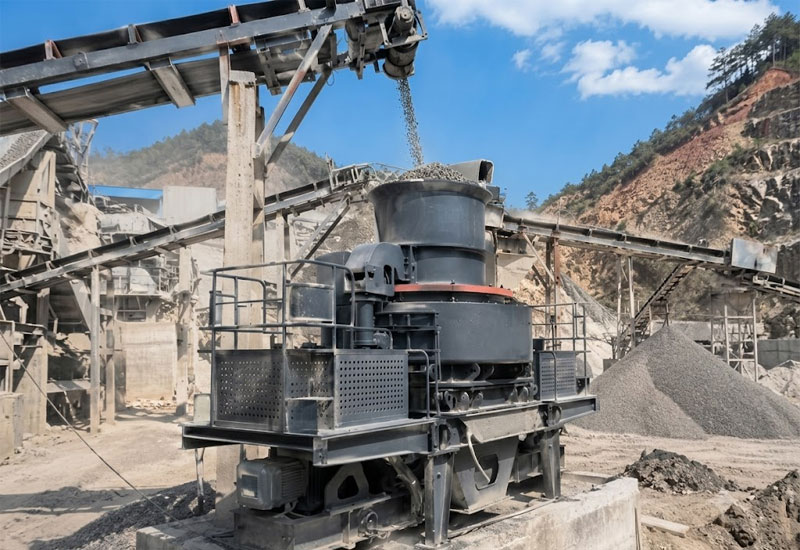
The VSI crusher is one of the most effective machines for producing high-quality manufactured sand from river gravel. Unlike conventional compression crushers, it uses high-speed rotor acceleration to throw stones against a rock-lined chamber or other particles.
This rock-on-rock or rock-on-anvil crushing mechanism breaks down oversized particles and improves their shape.
Key advantages include:
- Producing cubical and more uniformly shaped particles.
- Reducing excessive elongated and flaky particles.
- Controlling manufactured sand grading through adjustable operating parameters.
- Improving particle shape and surface characteristics.
- Producing fine aggregates suitable for concrete and other demanding applications.
VSI crushers are particularly suitable for the final crushing and shaping stage when the objective is to produce particles below 5 mm.
High-Efficiency Cone Crusher
A high-efficiency hydraulic cone crusher is an excellent choice for secondary and tertiary crushing of hard river stones.
River gravel frequently contains quartz and silica, making it highly abrasive. Cone crushers are designed to handle hard and abrasive materials through compression between the mantle and concave liner.
Their main benefits include:
- High crushing capacity and consistent output.
- Adjustable discharge settings for controlling particle size.
- Relatively high reduction efficiency.
- Reliable performance when processing hard river gravel.
- Lower susceptibility to impact-related damage than some conventional impact crushers.
Cone crushers are particularly effective for reducing medium-sized river stones before they enter the VSI shaping stage.
Impact Crusher
High-efficiency impact crushers can also be used for secondary or tertiary crushing, depending on the material characteristics and required product specifications.
They use high-speed impact forces to break stones into smaller particles. Their ability to produce relatively cubical aggregates makes them useful for applications where particle shape is important.
However, when processing highly abrasive quartz-rich river gravel, wear on blow bars and impact liners can be substantial. Therefore, operating costs and wear-part replacement intervals should be evaluated before selecting this equipment.
2. Recommended Crushing Process
For commercial manufactured sand production, a multi-stage crushing system generally delivers better results than relying on a single machine.
A typical production configuration includes:
- Primary crushing: A jaw crusher reduces large river stones into manageable feed sizes.
- Secondary crushing: A hydraulic cone crusher reduces the material to intermediate sizes.
- Tertiary crushing and shaping: A VSI crusher produces fine particles and improves particle shape.
- Screening: Vibrating screens separate finished aggregates according to particle size.
- Sand washing: A sand washing system removes excess clay, dust, and unwanted impurities when necessary.
Oversized particles can be returned to the tertiary crusher for further processing. This closed-circuit arrangement improves product consistency and reduces unnecessary waste.
3. Key Operational Factors Affecting Fine Particle Production
Crushing Reduction Ratio
The reduction ratio determines how effectively a crusher reduces incoming material size. Excessively high reduction ratios in a single crushing stage can increase energy consumption, wear, and the production of unwanted fines.
A staged crushing approach is generally preferable. Primary and secondary crushers should handle the main size reduction, while tertiary crushers and VSI machines perform final particle refinement and shaping.
The feed size, discharge opening, and material hardness must be matched to the equipment’s recommended operating range.
Manufactured Sand Production Yield
Sand production yield is an important indicator of plant profitability. It represents the proportion of usable fine material, typically below 5 mm, obtained from the total processed feed.
A VSI crusher can increase the production of manufactured sand by converting suitable intermediate-sized aggregates into finer particles.
However, maximizing fine output should not come at the expense of grading quality. Excessive production of ultrafine particles may increase water demand in concrete and create difficulties during washing and classification.
Efficient screening, recirculation, and feed-size control are therefore essential.
Particle Shape and Fineness Modulus
Particle shape directly affects aggregate packing density, workability, and concrete performance.
Rounded river stones naturally have smooth surfaces, which can be advantageous for workability but may provide less mechanical interlocking than properly shaped crushed aggregates.
VSI crushers help produce more cubical particles with improved surface characteristics.
Another important parameter is fineness modulus (FM), which indicates the overall coarseness or fineness of manufactured sand. It is calculated from the cumulative percentages retained on a specified series of standard sieves.
Adjusting VSI rotor speed, feed distribution, and screening settings helps control particle grading and achieve the required FM. The target should always follow the applicable construction standards and end-use specifications.
Moisture Handling
Moisture content can significantly influence crushing and screening performance.
Wet river gravel may contain surface water, clay, and fine sediments. Excessive moisture can cause material buildup, screen blinding, and reduced processing capacity.
An effective moisture management system may include drainage screens, pre-screening, controlled washing, and appropriate dewatering equipment.
For manufactured sand production, washing and classification systems can also help control the amount of fine dust and unwanted clay particles.
Wear-Part Durability
Quartz-rich river stones are highly abrasive, making wear resistance a major consideration when selecting crushing equipment.
VSI rotors, distributor plates, anvils, cone crusher mantles, concaves, and impact crusher blow bars are exposed to continuous abrasion.
To improve equipment durability and reduce maintenance costs, operators should consider:
- High-chrome or other suitable wear-resistant materials for impact crusher components.
- Tungsten carbide or specialized wear-resistant inserts for VSI components.
- High-manganese steel or application-specific alloy liners for cone crushers.
- Regular inspection and replacement of worn components.
- Consistent feed distribution to prevent localized wear.
Selecting wear parts according to actual material abrasiveness is essential for maintaining production efficiency.