
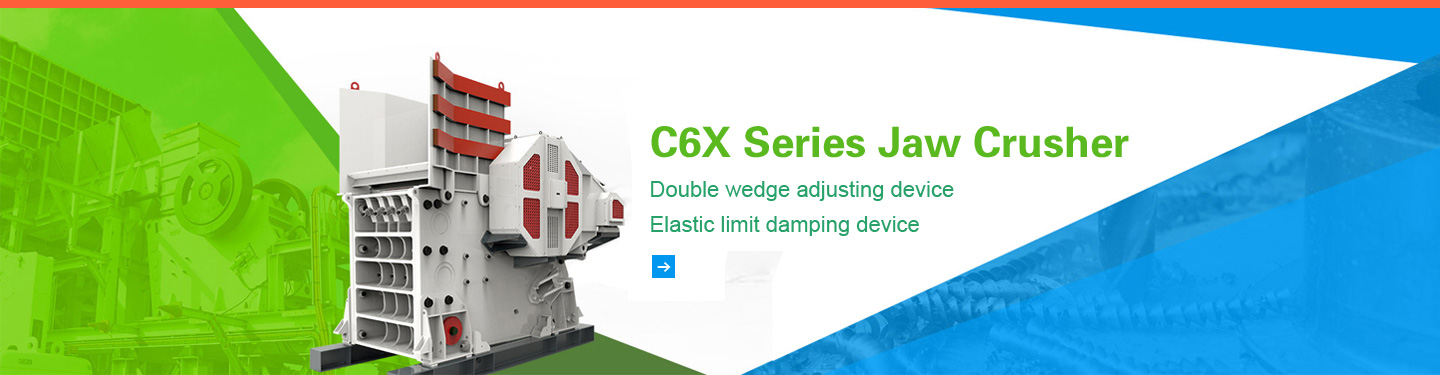
Processing highly abrasive, hard minerals like granite, feldspar, and quartz presents a severe engineering challenge. With high Mohs hardness ratings (typically 6 to 7+) and high silica content, these materials can obliterate standard crushing components in a matter of weeks, driving up operational expenditure (OPEX) and causing costly downtime.
To achieve a profitable yield while meeting strict industrial standards—such as specific particle size distributions (PSD) for industrial sand or strict contamination limits for glass-grade feldspar—operators must deploy a meticulously engineered, multi-stage crushing circuit.
The Core Strategy: Compressive vs. Impact Crushing
When dealing with highly abrasive materials, the fundamental rule of comminution is to rely on compressive crushing for the primary and secondary stages, reserving impact crushing strictly for the final shaping or ultra-fine stages if absolutely necessary.
-
Compressive Crushing (Jaw and Cone): Applies slow, immense pressure to fracture rocks along natural grain boundaries. This minimizes friction and significantly reduces wear-part consumption.
-
Impact Crushing (HSI and VSI): Uses high-velocity kinetic energy. While excellent for cubical particle shape, using a Horizontal Shaft Impactor (HSI) on quartz or granite will result in catastrophic wear-part degradation.
By balancing reduction ratios across a multi-stage circuit, operators can optimize energy efficiency and protect their equipment.
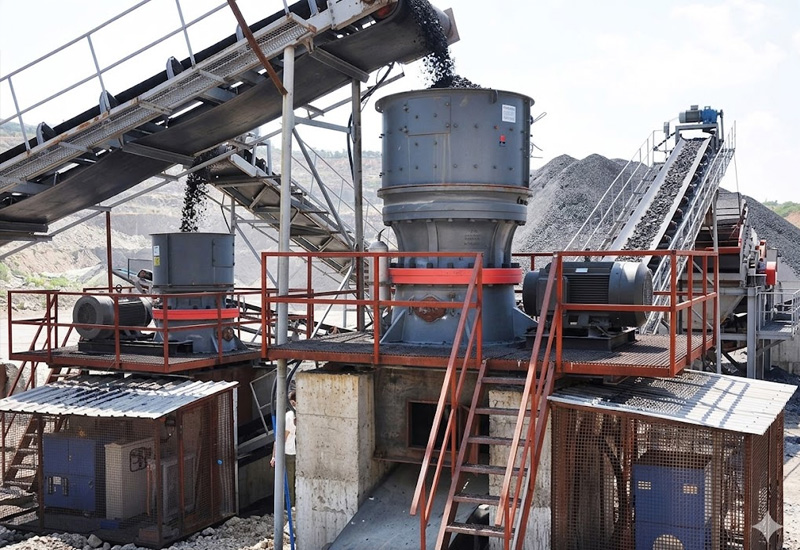
Phase-by-Phase Circuit Configuration
A robust circuit designed for hard, abrasive minerals relies on a three-stage (and sometimes four-stage) configuration.
1. Primary Crushing: Jaw Crusher
The objective of the primary stage is to accept run-of-mine (ROM) feed and reduce it to a manageable size for downstream processing, typically aiming for a reduction ratio of 3:1 to 5:1.
-
Equipment: A deep-chamber Jaw Crusher.
-
Wear Mitigation: Look for jaw plates cast from high-manganese steel (e.g., 18% to 22% Mn with 2% Cr). The deep chamber ensures an aggressive nip angle, preventing the material from slipping upward, which causes localized, premature wear.
-
Fines Removal: A Vibrating Grizzly Feeder (VGF) must precede the jaw crusher. Removing natural undersized fines before they enter the crushing chamber dramatically reduces abrasive wear on the jaw plates and prevents packing.
2. Secondary Crushing: Standard Cone Crusher
The secondary stage takes the primary crusher’s output and reduces it further, preparing a uniform feed for the tertiary stage.
-
Equipment: A Standard Head Cone Crusher operating in open or closed circuit.
-
Wear Mitigation: Cone crushers are ideal for abrasive rock because the mantle and bowl liner crush material through compressive force via an eccentric motion. Liners should be specified in heavy manganese steel.
-
Optimization: The cavity configuration (Extra Coarse, Coarse, or Medium) must match the feed size to ensure the crushing chamber is choked. Choke feeding (keeping the pocket above the head completely full) forces rock-on-rock crushing, which improves the reduction ratio and significantly reduces direct liner wear.
3. Tertiary Crushing & Fine Processing: Shorthead Cone vs. VSI
The final stage is dictated by the end-product requirements. If the goal is industrial sand (fractionated concrete/asphalt aggregates) or fine industrial mineral powders, a Shorthead Cone Crusher or a Vertical Shaft Impactor (VSI) is used, typically in a closed circuit with high-frequency vibrating screens.
-
Option A: Shorthead Cone Crusher (For High-Efficiency Fine Crushing)
-
Best for maximizing throughput of fine sizes while keeping wear costs low.
-
Operates at higher speeds and tighter closed-side settings (CSS) than a secondary cone.
-
-
Option B: “Rock-on-Rock” VSI Crusher (For Premium Particle Shape)
-
If the market demands a highly cubical particle shape or specific sand grading, a VSI is required.
-
Crucial Design: For quartz and granite, never use a shoe-and-anvil VSI. Instead, utilize a rock-on-rock configuration where an internal rock lining forms a natural crushing pocket. The rotor accelerates the material against a dense bed of the same mineral, completely eliminating wear on an outer anvil ring.
-
Mitigating Wear and Contamination
When processing feldspar and quartz for industries like glassmaking, ceramics, or solar panels, iron contamination is a critical failure point. Even microscopic traces of iron from steel liners can discolor glass or ruin a ceramic batch.
+-------------------------------------------------------------------------+
|                  CONTAMINATION & WEAR MITIGATION MATRIX                |
+-------------------------------------------------------------------------+
|     Phase     |      Equipment      |        Material Solution         |
+---------------+---------------------+-----------------------------------+
| Fine Crushing | VSI / Fine Cone     | Ceramic Liners (Alumina/Zirconia) |
| Transport     | Chutes & Hoppers    | UHMW-PE or Polyurethane Liners    |
| Separation    | Post-Crushing       | High-Intensity Magnetic Trommels  |
+---------------+---------------------+-----------------------------------+
Advanced Materials for Zero Contamination
To meet strict industrial mineral purity standards, alternative contact materials must be integrated into the fine processing stages:
-
Ceramic Liners: Lining VSI rotor parts, chutes, and transfer points with high-density alumina or zirconia ceramics prevents rock-to-steel contact.
-
Specialty Alloys: Where metal is unavoidable, using low-iron or high-chromium white irons can sometimes be permitted, provided down-stream magnetic separation is aggressive.
-
Polyurethane/Rubber: Screening media should utilize polyurethane or rubber instead of woven wire mesh to eliminate metal shedding into the final sand product.
Multi-Stage Iron Removal
A single magnet at the end of the line is insufficient. A robust circuit features an integrated, multi-stage magnetic separation strategy:
-
Overbelt Cross-Belt Magnets: Placed after the primary and secondary crushers to pull out large tramp iron (broken drill teeth, loader bucket teeth) before it damages downstream cones.
-
Rare-Earth Magnetic Pulleys: Integrated as head pulleys on discharge conveyors to catch medium-sized magnetic particles.
-
High-Intensity Wet/Dry Magnetic Separators: Positioned at the ultimate product output stage to extract fine liberated iron scale generated by unavoidable mechanical wear.
Summary of Circuit Design Success
Successfully crushing granite, feldspar, and quartz requires a strict engineering balance. By employing a Jaw $\rightarrow$ Standard Cone $\rightarrow$ Shorthead Cone/Rock-on-Rock VSI progression, operators maximize reduction ratios while honoring the physics of abrasive wear. When coupled with advanced ceramic linings and rigorous multi-stage magnetic separation, the circuit will reliably deliver high-spec, low-contamination industrial minerals at a sustainable operational cost.