
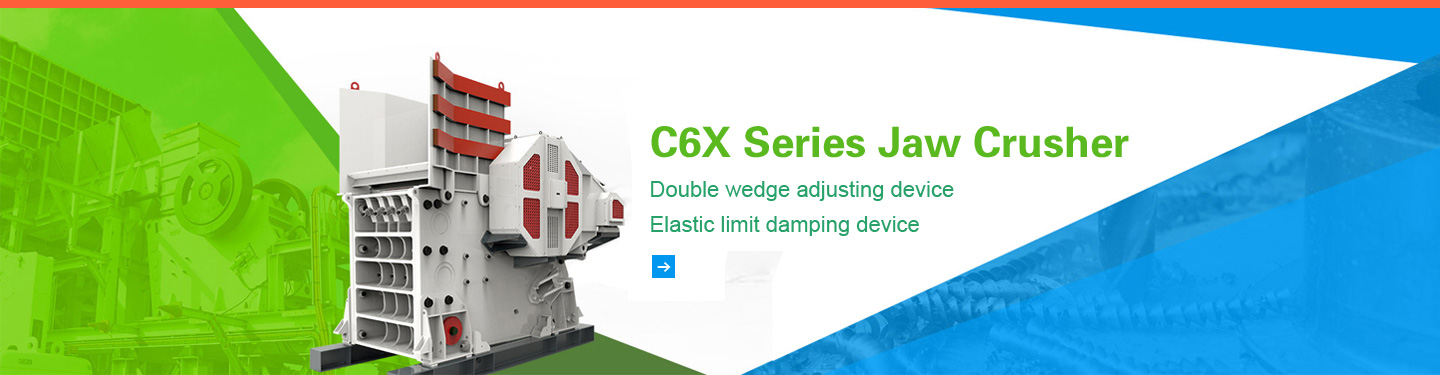
Transforming blasted rock from a mine into high-quality, cubical crushed stone requires more than selecting individual crushers. The complete crushing plant must be designed as a synchronized multi-stage circuit in which each machine receives material within its effective operating range and produces the correct feed for the next stage. A typical configuration combines a C6X Jaw Crusher for primary reduction, an HST or HPT Cone Crusher—or a CI5X Impact Crusher—for secondary and tertiary shaping, and an S5X Vibrating Screen for final classification and closed-circuit recirculation.
Primary Reduction with the C6X Jaw Crusher
The C6X Jaw Crusher forms the first major reduction stage. Its function is to accept large, irregularly shaped run-of-mine material and reduce it to a controlled size suitable for downstream crushing. Proper feed preparation is essential: excessive fines, sticky material, or oversized rocks can disrupt the crushing chamber and reduce throughput.
The crusher’s closed-side setting (CSS) is a key design parameter. CSS determines the minimum discharge opening and therefore strongly influences product size, reduction ratio, and downstream loading. A tighter CSS generally produces a finer product but can reduce capacity and increase power demand. A wider setting increases throughput but may overload the secondary crusher with oversized particles.
CSS should therefore be calibrated against the target feed size of the secondary stage rather than selected independently. The objective is a stable primary product with limited oversize variation, allowing the following crusher to operate continuously and efficiently.
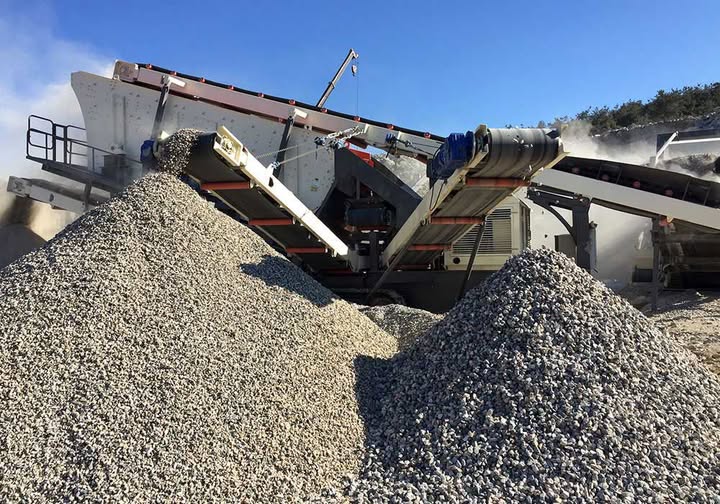
Secondary Crushing and Aggregate Shaping
After primary reduction, the material enters the secondary crushing stage. The choice between an HST/HPT Cone Crusher and a CI5X Impact Crusher depends on the rock characteristics and the required aggregate specifications.
HST or HPT Cone Crushers are well suited to hard and abrasive materials where controlled compression crushing is preferred. They can provide consistent reduction while maintaining high production efficiency. Correct CSS selection is again critical. If the setting is too large, excessive coarse material reaches the screen and recirculation increases. If it is too small, capacity can fall and unnecessary fines may be generated.
The CI5X Impact Crusher offers another approach, particularly when aggregate shape is a major priority. Impact crushing promotes particle fracture along natural weaknesses and can improve the cubical character of the final product. This makes the impact route attractive when controlling flakiness and elongation ratios is more important than maximizing wear-life in highly abrasive rock.
Final Classification with the S5X Vibrating Screen
The S5X Vibrating Screen provides the classification stage that converts the crushed material into defined aggregate sizes. Screen selection must match the plant’s production rate, feed characteristics, and required product gradations. Correctly sized screening media and sufficient screening area prevent excessive carryover of oversize particles.
The screen should be viewed as an active part of the crushing circuit rather than simply the final separation device. Oversize material is returned to the secondary crusher through a closed-circuit recirculation loop. This arrangement allows particles that have not reached the target size to be crushed again while correctly sized material leaves the circuit as finished product.
Synchronizing the Closed Circuit
The most important design principle is synchronization. The jaw crusher, secondary crusher, conveyors, and vibrating screen must operate as a balanced system. If the screen cannot process the secondary crusher’s output, material accumulates and plant capacity falls. Conversely, if the secondary crusher receives insufficient feed, its crushing chamber may operate inefficiently.
CSS calibration should therefore be coordinated across stages. The primary CSS establishes the secondary feed envelope, while the secondary CSS controls the amount of material that must return through the screen circuit. Screen apertures then determine the final product sizes and recirculation load.
Controlling Flakiness and Elongation
Producing cubical stone requires attention to particle shape throughout the circuit. Excessive reduction in a single crushing stage can generate unwanted flaky or elongated particles, while inappropriate crusher settings can allow poorly shaped particles to pass into the final product.
A balanced combination of compression and impact crushing, carefully selected CSS values, controlled reduction ratios, and efficient screening can significantly improve shape. The objective is not simply to achieve a target particle size, but to produce aggregate with a favorable cubical geometry and consistent gradation.
A properly engineered C6X–HST/HPT or CI5X–S5X circuit therefore operates as one integrated process. By synchronizing feed rates, CSS settings, screening capacity, and closed-circuit recirculation, the plant can efficiently transform mined rock into consistent, well-graded, cubical crushed stone suitable for demanding construction applications.