
Downstream liberation efficiency in auriferous processing plants depends fundamentally on the structural degradation achieved during secondary and tertiary comminution. In quartz-veined gold ores, where gold particles are tightly locked within mineral matrices of high rock compressive strength exceeding 200 MPa, conventional single-particle crushing fails to facilitate high leaching recovery rates. Advanced hydraulic cone crushers resolve this by transitioning from simple impact deformation to high-density inter-particle crushing principles. This thermodynamic and mechanical paradigm shifts the particle strain distribution, generating dense micro-fractures throughout the crushed ore matrix. By generating an optimized, cubical particle shape and exposing sub-micron gold clusters, these advanced systems prevent unliberated gold losses in downstream cyanidation and flotation circuits, accelerating the global capital payback velocity of complex mining operations.
Metallurgical Dynamics of Inter-Particle Crushing in Auriferous Matrices
The processing of quartz-veined gold ores demands a clear understanding of rock compressive strength and fracture propagation mechanics. Traditional secondary crushing methods rely on single-particle compression, where individual ore fragments are shattered between two steel surfaces. This often results in elongated, flaky particles that shelter unliberated gold grains within their core. Advanced hydraulic cone crushers utilize an accelerated eccentric speed coupled with a high-stroke crushing chamber to establish an entirely different mechanism: inter-particle crushing.
Under these conditions, the crushing chamber is maintained under a choke-fed condition. As the eccentric mantle sweeps through the chamber, it compresses a multi-layered bed of material rather than isolated rock fragments. The rock particles compress against one another at pressures exceeding their native rock compressive strength. This intense inter-particle friction alters the stress field within the mineral grains, resulting in several distinct mineralogical advantages:
- Volumetric Micro-Fracturing: High-stress inter-particle interactions generate localized shear stresses that propagate along internal grain boundaries and micro-faults. This induces extensive micro-fractures within the quartz and pyrite matrices without over-pulverizing the material into unrecoverable ultra-fine slimes.
- Exposure of Encapsulated Precious Metals: Gold particles locked along silicate boundaries are exposed due to preferential fracturing along weak mineral interfaces, significantly enhancing subsequent leaching recovery rates.
- Cubical Particle Geometry: Compressing the material bed eliminates flaky and elongated fractions, yielding an optimized final particle shape that displays high structural uniformity.
From a metallurgical perspective, the generation of internal micro-fractures directly affects downstream extraction kinetics. In carbon-in-leach and carbon-in-pulp systems, the lixiviant solution must penetrate the ore particle to dissolve the exposed gold. Elongated particles with intact internal structures restrict solution diffusion paths, lengthening the required residence time and driving up daily running costs. Particles heavily micro-fractured by inter-particle comminution display high effective porosity. This enables rapid cyanide solution penetration, ensuring high leaching recovery rates within standard tank residence times.
Technical Specification Mapping for Heavy-Duty Gold Comminution
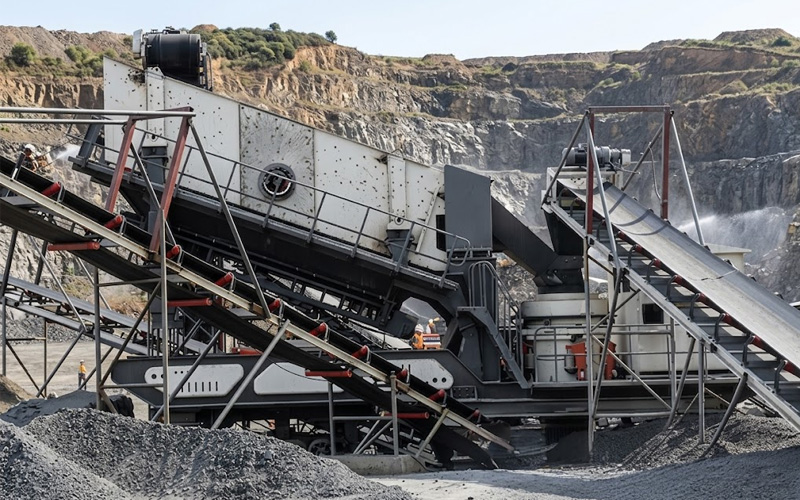
To withstand the rigorous mechanical demands of processing highly abrasive, gold-bearing quartzites, mechanical configurations must be cross-referenced against verified technical baselines. Selecting the proper secondary or tertiary crushing asset requires an exact alignment of machine energy inputs with the target material throughput. The following structural matrix outlines verified specifications for heavy-duty mining systems designed to handle high rock compressive strength while maintaining consistent volumetric reduction ratios:
| System Category | Equipment Model | Capacity (t/h) | Power (kW) | Maximum Feed Size (mm) | Primary Kinematic Mechanism |
|---|---|---|---|---|---|
| Secondary Mobile | NK300H (No Pre-screening) | 110-440 | 283 | 220 | Multi-Cylinder Hydraulic / High eccentric speed bed compression |
| Secondary Mobile | MK250H | 200-450 | 250 | 350 | Single-Cylinder Hydraulic / Fixed main shaft heavy-duty stroke |
| Secondary Mobile | KT250-2D | 88-360 | 250 | 88 | Single-Cylinder Hydraulic / Integrated mobile secondary configuration |
Analyzing these parameters reveals a direct correlation between installed power and particle liberation capability. Model MK250H accepts a maximum feed size of 350 mm, rendering it an exceptional configuration for processing run-of-mine primary jaw crusher discharge without risk of bridging across the intake hopper. It delivers a steady capacity range of 200-450 t/h backed by 250 kW of mechanical power, which provides the high energy input needed to crush tough quartz matrices. Conversely, the KT250-2D configuration utilizes its 250 kW power envelope within a tighter maximum feed constraint of 88 mm, making it an excellent candidate for tertiary fine crushing circuits where extreme inter-particle stress is required to generate high micro-fracture density before the milling stage.
Optimizing the Comminution Circuit to Maximize Downstream Extraction
Integrating a high-efficiency cone crusher into a gold mining project requires precise control over circuit kinematics, particularly the relationship between the closed side setting, eccentric throw, and recirculating load. In a typical closed-circuit setup, fine-screening loops return oversize materials back to the crusher chamber to guarantee a uniform particle size distribution before the ore progresses to ball or vertical grinding mills.
When configuring a multi-cylinder system like the HPT300 cone crusher deployed on the NK300H platform, which operates with a capacity range of 110-440 t/h and a power draw of 283 kW, the closed side setting must be calibrated precisely against the mineral grain size of the gold. If the closed side setting is opened too wide, the inter-particle bed density drops, shifting the system back toward inefficient single-particle impact. This increases the proportion of flaky fragments and lowers the density of micro-fractures, which places an excessive grinding load on downstream milling equipment and escalates fuel and power expenses per shift.
Maintaining a packed, choke-fed chamber ensures that the 283 kW of mechanical energy is transferred directly into inter-particle stress fields. This optimization minimizes wear on the manganese liners, reduces overall expenditure per shift, and enhances the operational lifetime of the machine components. The resulting uniform, micro-fractured cubical discharge accelerates the subsequent grinding stage, allowing ball mills to achieve the target liberation mesh size faster while using significantly less electrical energy per ton of processed ore.
Frequently Asked Questions Regarding Comminution in Gold Extraction
- How does inter-particle crushing improve leaching recovery rates compared to traditional impact crushing?
- Inter-particle crushing exerts multi-directional compressive forces within a dense bed of material rather than hitting isolated rock fragments. This induces localized shear stresses along internal mineral grain boundaries, creating extensive internal micro-fractures within the quartz matrix. These micro-fractures provide downstream cyanide leaching solutions with direct pathways to encapsulate gold grains, speeding up dissolution kinetics and increasing total gold extraction without generating excess fine slimes.
- Which specific parameters should be monitored to prevent unliberated gold losses in tough quartz ores?
- Operational teams must continuously monitor the closed side setting stability, eccentric shaft speed, and power draw fluctuations under choke-fed conditions. Maintaining an optimal bed density ensures that the machine consistently produces cubical particles and micro-fractures rather than elongated, unbroken slabs that shield gold grains from the leaching reagents.
- What role does maximum feed size play when integrating a cone crusher into a gold processing line?
- The maximum feed size defines the operational limits of the secondary crushing stage to prevent material bridging at the intake throat. For instance, heavy-duty single-cylinder configurations like the MK250H accommodate up to a 350 mm feed size, making them ideal for handling coarse primary jaw crusher discharge. Matching the feed size precisely to the chamber profile prevents uneven mantle wear and maintains the steady material choke necessary for efficient inter-particle compression.
Expert Consultative Diagnostic Assessment
Maximizing mill throughput and extraction recovery rates requires moving past oversimplified equipment sizing charts. What is your current rock compressive strength and mineralogical grain size variation across your gold mining project? Send our application engineers your exact feed size profiles, current manganese liner wear-part life cycles, and downstream milling energy targets, and we will conduct a rigorous comminution circuit analysis to optimize your final particle shape and reduce your overall expenditure per shift.